
Features
Abundant Rivers, Scarce Fish: The Paradox of Fishing in Lokoja
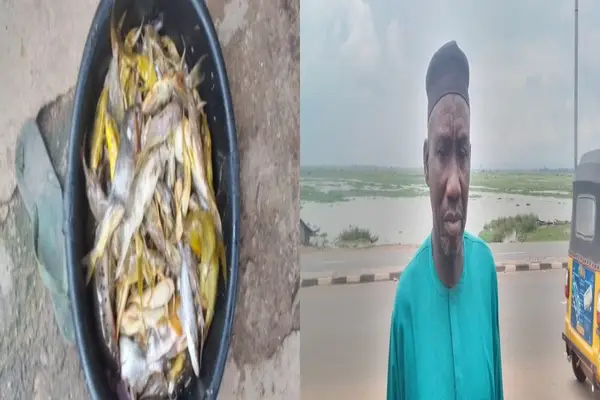
Despite being home to Nigeria’s only confluence of two major rivers, Lokoja, the Kogi State capital, continues to grapple with fish scarcity, leaving residents with limited access to an important source of protein. In this feature, Aminu Yusuf examines the factors responsible for the persistent shortage of fish in Lokoja and its impact on residents.
It is difficult to explain the prevailing high cost of fish in Kogi State, particularly in Lokoja, the state capital. By geographical advantage, Kogi has more rivers and streams than many states in Nigeria. Apart from the Niger Delta region, Kogi, where the River Niger and River Benue meet before flowing southwards into the Atlantic Ocean, should naturally be a major fishing hub.
By nature, fish thrive in water. Yet, despite its abundant water resources, fish remains an increasingly expensive and, in some places, scarce commodity in Kogi State.
Of the 21 local government areas in Kogi State, seven Idah, Ibaji, Ofu, Bassa, Ajaokuta, Lokoja and Kogi are riverine communities. Other local government areas also have major rivers and streams that could support fishing activities. To crown it all, Lokoja, the state capital, is home to the famous confluence of the River Niger and River Benue.
It is therefore an irony that fish should be scarce and expensive in a state so richly endowed with water resources. A visit to markets across Kogi State confirms the reality. The prices of fish are often high enough to make consumers wonder how a state surrounded by rivers could experience such scarcity.
As you move through the streets and major markets in Lokoja, checking the prices of different types of fish, it is easy to conclude that the rivers surrounding the state have little or no fish. Yet, that assumption quickly becomes difficult to sustain when one considers the fishing communities that have existed along these waterways for generations.
My curiosity took me to Kabawa, a renowned fishing settlement in Lokoja where the lives of the people are closely intertwined with the river. At Kabawa, the river runs parallel to the only major road serving the community, with residents living on one side and the river stretching along the other.
Kabawa has been a fishing settlement for centuries, with generations of residents depending almost entirely on fishing for their livelihood. Members of the community have also participated in the Kogi Fishing Festival, reportedly dating back to 1871.
For the fishermen, fishing is more than an occupation; it is a way of life. They spend hours on the river at different times of the day, depending on their knowledge of fish movement and behaviour. They know when to cast their nets, whether at midnight, dawn or dusk, based on years of experience and an understanding of the river.
The head of the fishermen in Lokoja, popularly known as the Sarkin Ruwa, meaning “King of the Water,” is Alhaji Muhammed Abubakar Tokura. At 61, Tokura has spent virtually his entire life around fishing and the river.
A former correctional officer who served with the Nigerian Correctional Service, Tokura said he is not surprised by the current state of fishing in Lokoja.
“My name is Muhammed Abubakar Tokura. I am the Sarkin Ruwa of Lokoja. I am 61 years old. I served and retired from the Nigerian Correctional Service as a prison warder,” he said.
He went on, “I started fishing at a very tender age, right from when I was in primary school. After my primary school my father bought me a fishing net and told me to go and fish to train myself in secondary school. I had already received the training during my primary school days, so my father was satisfied that I’ve got enough experience to go fishing on my own. And I started fishing on my own. After my secondary school I had an opportunity to join the Nigerian Correctional Services, so I wrote the application and I was employed as a Prison Warder now Correctional Service. I served there for thirty-five years successfully and retired. After retirement and returned back home to continue my fishing. Even when I was in service, I return during my annual leave to fish.
“One of the major reason why we see high cost of fish in Lokoja, it is not because there is no fishes in the river, it is not because the river has dried up, the rivers are still there forever. The problem is the fishermen. We don’t have professional fishermen anymore, youths of these days are pursuing other means of livelihood, our youths are no longer interested in the profession of their fathers.
“The second problem is growth in population. The population of people in Lokoja as at 50 years ago may have multiply in thousand folds. But the size of the river has not increased. The harvest nowadays is not enough to feed the growing population. Another issue is, people consume fish than meat daily. Many residents can do without meat but they cannot do without fish. In every pot of soup there must be fish, then look at the population where are the fish coming from, there are no fishermen as it used to be. Yes, there are fishes in the rivers, but where are the fishermen? The interest in fishing is declining fast and government is not encouraging youths to go into fishing like they do for crop farmers. You know government give good support crop farmers, but we fishermen we don’t enjoy support from government, and so our children are losing interest in fishing.
“Another thing that reduced and discouraged professional fishermen is the annual fishing festival. Lokoja used to have our fishing festival since as far back as 1871, but unfortunately, that fishing festival stopped for about 10 years now. The state government suspend the festival due to conflict between Lokoja fishermen and Koton fishermen from across the river. Fishermen from Lokoja claimed ownership of the river, while those in Koto were also making the same claim. So it got to a level that the disagreement resulted to violent clash, and the state government had to intervene and shut down the festival to avoid the conflicts. So, the crisis in the fishing festival was also a major issue. If not, on the day of the fishing festival we will harvest so much fishes and the person that catches the biggest fish will be celebrated as a professional. During the annual festival we will harvest so much fish than we can consume, so we sell the fish to raise money for other things. I mean fishing is our economic life, with money from fishing someone can build his house, marry, train your children, buy cars and do plenty things from fishing. The proceeds of fishing comes daily because everyday you are on the river, day and night we are on the river. So we never lack food, we never lack money.
“When I was in secondary school, when it is time to pay school fees, I will use just one day, or one night on the river fishing, by the time I return and sell the fish, the proceeds will be more than enough for my school fees.
“So, current scarcity of fish is simply due to higher demand for fish. The demand for fish in Lokoja is higher than the supply. Lokoja is a state headquarter, and it attracted many people from the 21 LGAs there, so how do we get the fish to feed the population of people in the state capital. So, fish is costly in our markets because the river has not changed but the population of fish consumers has increased.
“In those days , around 1990 or 1991 the year I join the Correctional Service, the biggest fish then we sold it at the sum of N200.00, the same size of fish now goes for N300 to N500,000 The biggest fish now in the river we called it “Giwa” (Elephant fish) now sell as high as N400,000 I mean the type we used to sell for N200 about 30, 40 years ago. So, 30, 40, 50 years ago we have surplus of fishes because the population was smaller, but today the population has exploded beyond the supply.
“You cannot compare fishing nowadays with that of the olden days. In fishing, in the past there was control, there were regulations, there were ethics. For instance, then when we throw our net into the river, when we pull out the net from the water, we pick the matured fish and returned the small small fish back into the river. This is to allow smaller fish to grow, lay eggs and produce thousands of fishes before we harvest it. But nowadays, I don’t know whether because of hunger, people now go about harvesting small fish, to a level that people now use mosquito nets for fishing. We have intercepted those using mosquito nets and ceased their nets plenty of times, we have those seized mosquito nets as evidence. As professional fishermen, we practice fishing by allowing small fishes to grow, but these days so many unprofessional fishermen have taken over.
“This will tell you that you the pressure on people to get fish from the river has made people to abuse the rules of the game. And as people go about harvesting small fishes there is no regeneration of fishes, we no longer allow fish to hatch it’s egg and multiply the breeds.
“Obviously, the population of fish consumers are tripped those of the fish producers, hence the price of fish must be on the rise. The major way to bring down the price of fish in the market is to increase harvest by fishermen, and that will require government support. Government is already supporting crop farmers with inputes like fertiliser, tractors and chemicals, but government is not doing same in the fishing sector.
“I’m worried that youths are no longer interested in fishing, and I have been appealing to my members to allow their own children go into fishing so that the profession will not die. But most of the encouragement must come from the government. I have been expecting a day when government will call us, I mean our association to dialogue with us on how to improve fishing in Lokoja”.










NYSC to Open Online Registration Portal for 2026 Prospective Corps Members in September

Again Residents Confront Scavenger Over Alleged Vandalism in Kosofe

GBB Reaffirms Digital Infrastructure Drive

Nigeria to Roll Out Unique Postcodes for Every Home October 1
