
AI
Nigeria Needs AI to Protect Election Integrity, Not Choose Leaders – Analaize CEO
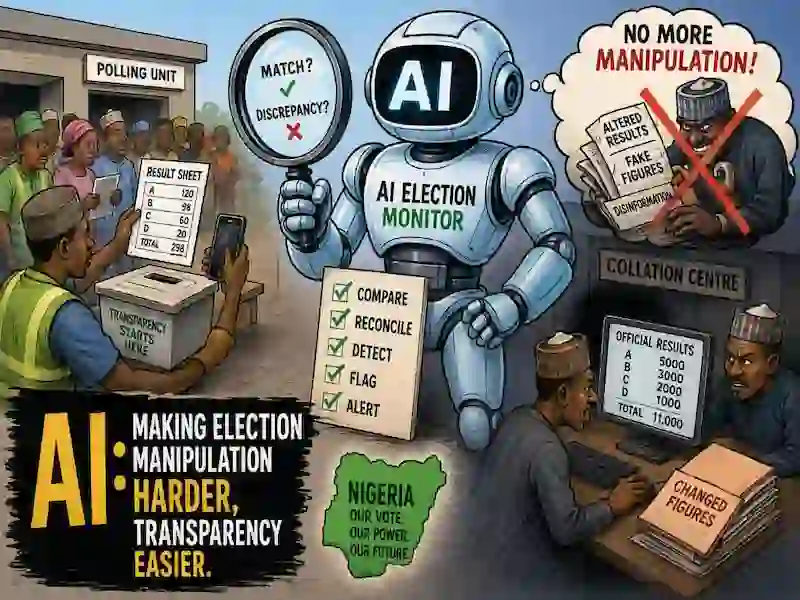
Nigeria needs to deploy artificial intelligence (AI) to strengthen election transparency and make it more difficult to manipulate electoral results, the Chief Executive Officer of Analaize, Mmadubuko Michael, has said.
Michael made the remarks while speaking with National Focus in a phone conversation, where he explained how AI could be used to monitor the electoral process and identify discrepancies between results recorded at polling units and figures eventually declared.
He said the focus should not be on building an AI system that determines who wins an election, but on using technology to help Nigerians detect when election results do not correspond with what happened at polling units.
According to him, election rigging is not limited to ballot-box manipulation, as it can also occur through the manipulation of results, inconsistencies during collation, altered documents and coordinated misinformation.
Michael said there could be significant discrepancies between what happens at polling units and what is eventually declared during the collation process.
“AI can connect those dots for us,” he said, advocating an independent AI-powered election monitoring system capable of tracking results from polling units through wards, local government areas and states.
He explained that such a system could compare results sheets with transmitted results, reconcile figures at different stages of collation and flag mathematical inconsistencies.
Michael added that AI could identify abnormal voting patterns, duplicate or suspicious result sheets and potentially manipulated images.
He said the technology could also flag situations where the number of accredited voters or the population of an electoral area does not correspond with the figures eventually declared.
“When something doesn’t add up, it doesn’t say AI will not come out and say this election was rigged. It will clearly say, ‘Investigate this polling unit,’” he explained.
The Analaize CEO proposed that voters and observers at polling units should photograph result sheets immediately after results are recorded, creating independent, time-stamped evidence that could be compared with official results.
“If they match, it automatically becomes verified. If they don’t, discrepancy detected,” Michael said.
He noted that such a system, if deployed across Nigeria’s more than 180,000 polling units, could transform election monitoring by providing real-time evidence of discrepancies and suspicious activities.
Michael stressed that AI would not replace the Independent National Electoral Commission (INEC), election observers, journalists or political parties, but would give them the speed, scale and evidence required to monitor the electoral process more effectively.
He warned that waiting until months after an election to discover that thousands of results do not reconcile could be too late, particularly after elected officials had been sworn into office.
“The objective shouldn’t be to build an AI that decides who won an election. The objective should be to build an AI that makes it extraordinarily difficult to severely change what happened,” he said.
Michael argued that Nigeria could draw lessons from the use of AI in detecting fraud in banking, cybersecurity and financial systems and apply similar technology to protect the integrity of elections.
“The future of election integrity may not be another voting machine. It may be an AI watching the entire electoral system, one polling unit at a time,” he said.
He added: “Nigeria doesn’t need AI to choose our leaders. Nigeria needs AI to help make sure that people choose them, not them choosing themselves.”











NYSC to Open Online Registration Portal for 2026 Prospective Corps Members in September

Again Residents Confront Scavenger Over Alleged Vandalism in Kosofe

GBB Reaffirms Digital Infrastructure Drive

Nigeria to Roll Out Unique Postcodes for Every Home October 1
