
Editorial
Can AI Solve Nigeria’s Healthcare Challenges?
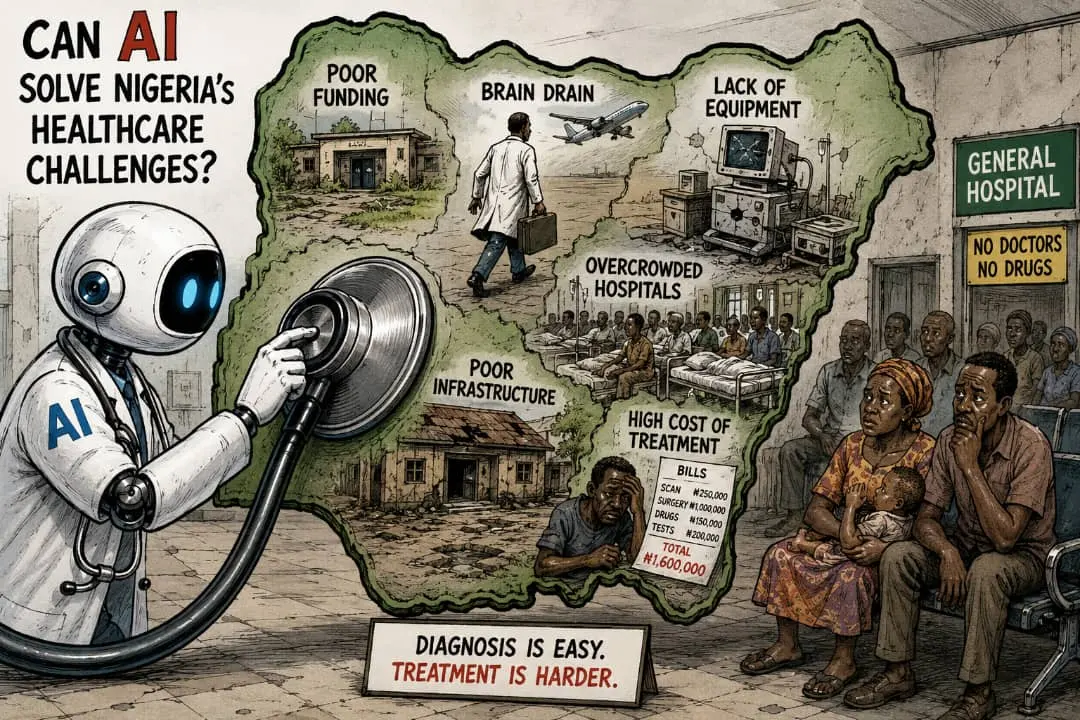
Can AI solve Nigeria healthcare challenges? These is the question many Nigerians are asking. Nigeria’s healthcare system stands at a critical crossroads. Despite being Africa’s most populous nation, the country continues to struggle with inadequate healthcare infrastructure, a shortage of skilled medical professionals, rising disease burdens, and unequal access to quality healthcare services. For millions of Nigerians, particularly those living in rural communities, timely and affordable healthcare remains out of reach.
Against this backdrop, Artificial Intelligence (AI) has emerged as one of the most promising technological innovations capable of transforming healthcare delivery. The question, however, is not whether AI is powerful, but whether it can genuinely address Nigeria’s healthcare challenges.
Artificial Intelligence refers to computer systems designed to perform tasks that typically require human intelligence, including learning, problem-solving, decision-making, speech recognition, and pattern recognition. In healthcare, AI is increasingly being used worldwide to assist doctors in diagnosing diseases, interpreting medical images, predicting disease outbreaks, managing electronic health records, discovering new medicines, and supporting virtual healthcare consultations.
Countries with advanced healthcare systems have embraced AI not as a replacement for healthcare professionals, but as a tool that enhances accuracy, efficiency, and patient outcomes.
Nigeria stands to benefit significantly from this technological revolution. One of the country’s most pressing healthcare challenges is the shortage of medical personnel. Reports indicate that Nigeria has one of the lowest doctor-to-patient ratios globally, as many healthcare professionals continue to seek better opportunities abroad. The result is overcrowded hospitals, prolonged waiting times, delayed diagnoses, and increased pressure on the limited workforce.
AI-powered diagnostic systems and clinical decision-support tools can help ease this burden by enabling healthcare professionals to analyse medical data more quickly and accurately. This would allow doctors to attend to more patients while maintaining high standards of care.
AI also offers enormous potential to improve healthcare access, particularly in underserved rural communities where medical facilities are limited. Through AI-enabled telemedicine platforms, patients can consult healthcare providers remotely, receive preliminary assessments, and access medical advice without travelling long distances.
AI-powered chatbots can answer basic health questions, remind patients to take prescribed medications, monitor chronic illnesses, and advise individuals on when to seek urgent medical attention. In communities with limited healthcare infrastructure, such innovations could bridge the gap between patients and healthcare providers.
Another area where AI could make a significant impact is disease surveillance. Nigeria continues to battle infectious diseases such as malaria, cholera, Lassa fever, and tuberculosis while experiencing a steady rise in non-communicable diseases, including hypertension, diabetes, and cancer.
By analysing vast amounts of health data, AI systems can identify unusual disease patterns, predict outbreaks, and support public health authorities in responding before isolated cases develop into widespread health emergencies. The COVID-19 pandemic demonstrated the importance of rapid data analysis and early warning systems in protecting public health.
Hospital administration is another area ripe for AI-driven transformation. Many public healthcare facilities still rely heavily on paper-based record-keeping, making patient information difficult to retrieve and increasing the likelihood of medical errors. AI-supported electronic medical records can improve efficiency, reduce duplication, strengthen patient management, and support better clinical decision-making.
Similarly, AI can automate appointment scheduling, improve inventory management for essential medicines, and optimise the allocation of limited healthcare resources, helping hospitals operate more efficiently.
However, despite its enormous potential, it would be unrealistic to conclude that AI alone can solve Nigeria’s healthcare crisis. Technology cannot compensate for decades of underinvestment in the health sector. Many healthcare facilities continue to operate without reliable electricity, stable internet connectivity, modern medical equipment, or adequate funding. Deploying sophisticated AI systems in poorly equipped hospitals would produce only limited benefits.
Equally important is the issue of human capacity. AI systems require skilled professionals to design, deploy, maintain, and interpret their outputs. Nigeria still faces a shortage of experts in artificial intelligence, data science, biomedical engineering, and digital health. Without sustained investment in education, research, and professional training, the country may struggle to realise AI’s full potential.
Healthcare professionals must also be trained to work alongside AI technologies while retaining their professional judgment. No algorithm can replace the experience, compassion, ethical responsibility, and critical thinking that medical practitioners bring to patient care.
Data privacy and ethics also deserve careful attention. AI systems rely on access to large volumes of patient information. Without strong legal and regulatory safeguards, there is a risk of data breaches, misuse of sensitive information, algorithmic bias, and discrimination.
Public confidence in AI-driven healthcare can only be achieved through transparent governance, robust cybersecurity measures, and strict compliance with data protection laws that safeguard patients’ rights.
The financial cost of implementing AI cannot be ignored either. Building digital infrastructure, acquiring advanced technologies, maintaining software systems, and training personnel require substantial investment. At a time when Nigeria faces numerous competing developmental priorities, policymakers must ensure that investments in AI complement broader efforts to strengthen primary healthcare, improve hospital infrastructure, expand health insurance coverage, and retain skilled medical professionals.
The future of AI in Nigeria’s healthcare system therefore lies not in replacing healthcare workers but in empowering them. AI should be viewed as an intelligent assistant that enhances diagnosis, improves efficiency, reduces medical errors, and expands access to quality healthcare services. Its success, however, will depend on strong political commitment, effective public-private partnerships, sustained research, reliable infrastructure, and policies that promote responsible innovation.
Nigeria must seize this opportunity by investing in digital health infrastructure, expanding broadband connectivity to healthcare facilities, improving electricity supply, supporting local AI research, encouraging innovation among technology startups, and establishing clear ethical guidelines for AI deployment in healthcare. Universities, research institutions, government agencies, healthcare providers, and the private sector must work together to develop home-grown AI solutions tailored to Nigeria’s healthcare realities rather than relying solely on imported technologies.
Ultimately, the answer to the question is both yes and no.
Yes, AI has tremendous potential to address many of Nigeria’s healthcare challenges by improving diagnosis, expanding access to medical services, strengthening disease surveillance, and supporting healthcare professionals.
However, AI cannot single-handedly solve systemic problems rooted in inadequate funding, poor infrastructure, weak governance, and workforce shortages. Technology is most effective when it strengthens systems that already function well; it cannot replace political will or institutional reform.
As Nigeria seeks to build a more resilient healthcare system, Artificial Intelligence should be embraced as a catalyst for transformation rather than a cure-all. If deployed responsibly and supported by strategic investments, sound policies, and capable professionals, AI can become one of the nation’s most valuable tools for delivering accessible, efficient, and quality healthcare.
The future of Nigeria’s healthcare system will not be determined by artificial intelligence alone, but by the intelligent decisions the nation makes today.
Whether AI can solve Nigeria healthcare challenges will depend on infrastructure, funding, and responsible implementation.”















NYSC to Open Online Registration Portal for 2026 Prospective Corps Members in September

Again Residents Confront Scavenger Over Alleged Vandalism in Kosofe

GBB Reaffirms Digital Infrastructure Drive

Nigeria to Roll Out Unique Postcodes for Every Home October 1
